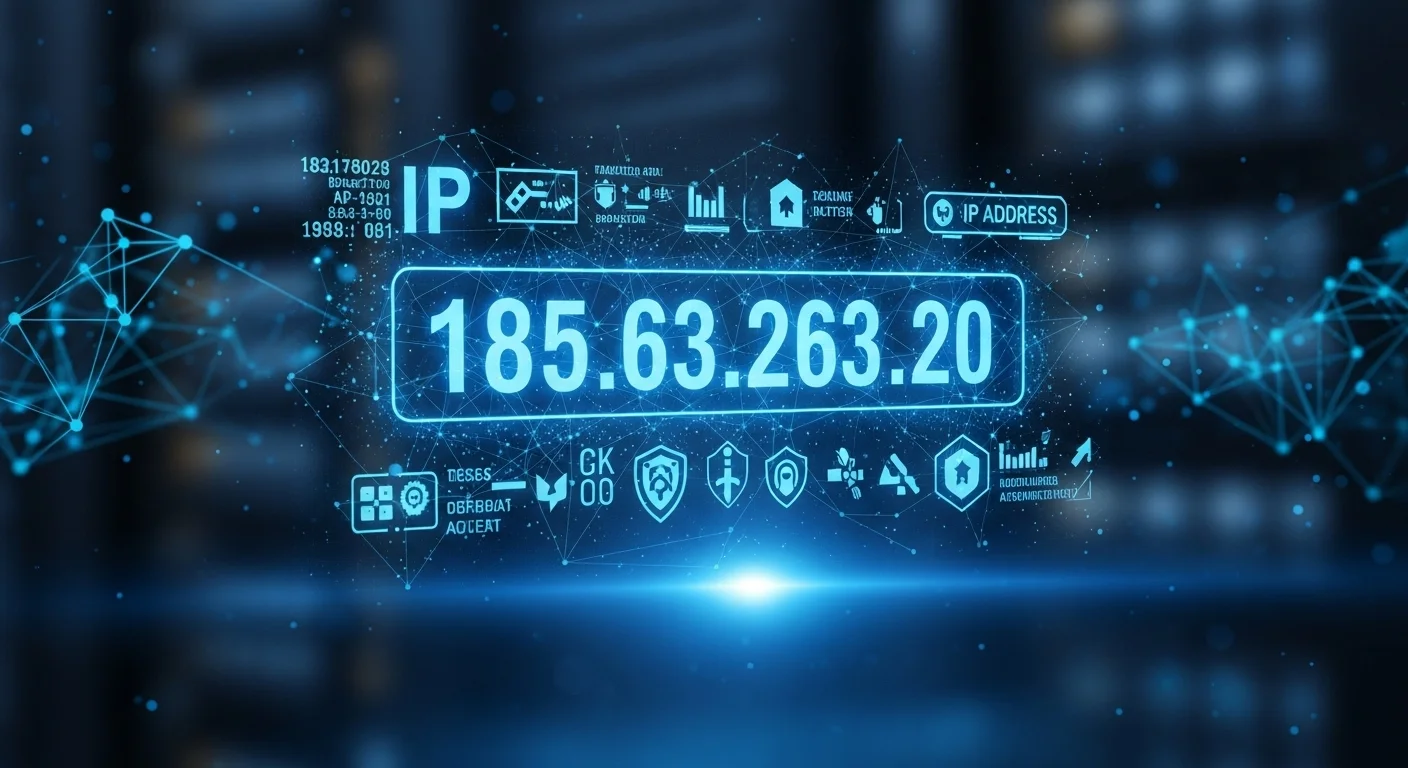
185.63.263.20 – A Deep Dive into the Meaning, Context, and Implications of an IP Address
In the digital world, numbers often carry more meaning than words. One such example is 185.63.263.20. At first glance, it looks like a random string of digits separated by dots. However, anyone familiar with networking immediately recognizes it as an IP address. While it may seem simple, an IP address represents identity, location, access, and digital interaction all at once.
In this comprehensive article, we will explore what 185.63.263.20 represents, how IP addresses function, what technical details may be associated with such an address, potential security considerations, legal implications, and how businesses and individuals interact with IP-based systems. The discussion will be detailed, professional, and easy to follow—written casually but with expert-level clarity.
Understanding What 185.63.263.20 Actually Is
To begin with, 185.63.263.20 appears to be an IPv4 address. IPv4 (Internet Protocol version 4) uses a 32-bit format written in dotted decimal notation, typically structured as four octets separated by periods. Each octet ranges from 0 to 255. That detail is important because it tells us something critical about this specific string.
In a technically valid IPv4 address, each number between the dots must fall within the range of 0 to 255. Looking closely at 185.63.263.20, we notice that “263” exceeds the maximum allowable value of 255. This means that 185.63.263.20, as written, is not technically a valid IPv4 address.
That fact alone is significant. It suggests one of several possibilities: a typographical error, a masked IP for anonymity, a fictional placeholder, or even a malformed entry in a system log. In cybersecurity and networking contexts, malformed IP addresses can sometimes signal misconfiguration, logging issues, or attempts at obfuscation.
From an expert standpoint, the first thing any network administrator would do upon encountering 185.63.263.20 is verify its accuracy. Is it a transcription mistake? Was it meant to be 185.63.236.20? Or perhaps 185.63.26.20? These small differences matter enormously in network diagnostics.
How IP Addresses Work in the Real World
To understand the implications of 185.63.263.20, we need to understand how IP addresses function.
An IP address serves as a unique identifier for devices connected to a network. Whether it’s a home computer in Pakistan, a cloud server in Europe, or a mobile phone accessing a website, each device must have an IP address to send and receive data.
When you type a website URL into your browser, behind the scenes, a DNS (Domain Name System) server translates that domain into an IP address. The browser then connects to that IP address to retrieve content. In essence, IP addresses are the numerical backbone of internet communication.
Public IP addresses are globally routable, meaning they can be accessed over the internet. Private IP addresses, on the other hand, are used within internal networks. The number pattern 185.x.x.x typically falls within public address ranges assigned by regional internet registries.
This makes the format of 185.63.263.20 interesting. The 185.0.0.0/8 range is commonly associated with European IP allocations through RIPE NCC. But again, since 263 is outside the valid octet range, the address itself cannot function in routing systems.
The Technical Invalidity of 185.63.263.20
Let’s break down the technical issue clearly.
IPv4 addresses consist of four octets:
-
Each octet must range from 0 to 255.
-
Values above 255 are mathematically impossible within an 8-bit segment.
-
263 requires 9 bits to represent, which violates IPv4 structure.
Therefore, routers, switches, and network stacks would reject 185.63.263.20 as invalid input. Any system attempting to parse it would throw an error.
In programming environments, such as Python or network firewall configurations, input validation would fail immediately. For example, entering this IP into a firewall rule would generate a format error.
From a cybersecurity perspective, malformed IP addresses can sometimes be indicators of:
-
Log injection attempts
-
Faulty monitoring systems
-
Data corruption
-
Intentional obfuscation
However, without additional context, it remains simply an invalid IPv4 structure.
Possible Reasons You Might Encounter 185.63.263.20
Even though it is technically invalid, there are real-world scenarios where such an address might appear.
1. Typographical Error
Human error is the most common explanation. A single misplaced digit can convert a valid IP into an invalid one.
2. Data Scraping or Bot Activity
Automated scripts sometimes mishandle numeric data. During scraping or formatting, numbers may accidentally concatenate or increment improperly.
3. Placeholder or Fictional Entry
In tutorials, testing environments, or documentation, people sometimes invent IP-like numbers for demonstration purposes.
4. Corrupted Log File
If a server log becomes partially corrupted, numeric segments can shift, producing impossible values like 263.
For network administrators, the key step is verification through authoritative lookup systems such as WHOIS databases or routing tables.
Security Implications of Suspicious IP Entries
When an unusual IP address appears in logs, even an invalid one, it should not be ignored.
Cybersecurity professionals treat anomalies seriously. Even malformed entries can be part of larger patterns. For instance:
-
Attackers may intentionally insert malformed addresses to test validation systems.
-
Log tampering could include corrupted IP entries.
-
Application vulnerabilities may surface through improper IP parsing.
An expert approach involves:
-
Cross-checking timestamps.
-
Comparing with surrounding log entries.
-
Verifying DNS resolution.
-
Running intrusion detection scans.
However, it is important not to jump to conclusions. Most malformed IP entries turn out to be benign data errors rather than malicious activity.
How Businesses Handle IP Address Monitoring
Modern businesses rely heavily on IP monitoring systems. Web servers log visitor IPs. Firewalls analyze inbound and outbound traffic. Security platforms monitor suspicious behavior based on IP reputation.
If a system recorded 185.63.263.20, a security analyst would likely:
-
Validate the IP format.
-
Attempt reverse DNS lookup.
-
Check against threat intelligence databases.
-
Confirm whether it is syntactically correct.
Because 263 is invalid, automated monitoring systems would typically discard the entry or flag it as malformed input.
Advanced security systems incorporate validation layers to prevent improper data from contaminating analytics dashboards.
Legal and Privacy Considerations Around IP Addresses
IP addresses are often considered personal data under privacy regulations, particularly when they can be linked to individuals. Laws such as GDPR in Europe treat IP addresses as potentially identifiable information.
Even though 185.63.263.20 is invalid, real IP addresses are sensitive. Logging, storing, and analyzing them requires compliance with local laws.
For example:
-
Companies must disclose IP logging practices in privacy policies.
-
Data retention limits may apply.
-
Access controls must protect stored logs.
The technical structure of an IP address may seem trivial, but its legal implications are substantial.
The Future of IP Addressing: IPv4 vs IPv6
One reason malformed IP addresses appear more frequently today is the growing transition from IPv4 to IPv6.
IPv4 has approximately 4.3 billion addresses. Due to internet expansion, that pool has largely been exhausted. IPv6 was introduced to solve this limitation, offering an astronomically larger address space.
IPv6 addresses look entirely different. They are written in hexadecimal format and separated by colons rather than dots.
The appearance of invalid IPv4 addresses sometimes results from misconfigured systems that attempt to translate IPv6 values improperly into IPv4 fields.
Understanding this transition helps contextualize anomalies like 185.63.263.20.
Troubleshooting Steps If You Encounter 185.63.263.20
If you encounter this IP address in logs or documentation, here’s a structured approach:
-
Confirm the source of the entry.
-
Check whether it appears elsewhere consistently.
-
Verify input validation mechanisms.
-
Examine whether nearby entries show similar corruption.
-
Correct the value if it was a simple typo.
From an expert perspective, the goal is systematic validation rather than assumption.
Conclusion
At first glance, 185.63.263.20 appears to be an ordinary IP address. However, closer examination reveals that it is technically invalid due to the octet value exceeding 255.
This simple detail opens up broader discussions about how IP addresses function, how networks validate data, how cybersecurity teams monitor anomalies, and how digital systems depend on strict numerical structures.
In networking, precision matters. A single digit can determine whether data flows smoothly across global infrastructure or fails instantly. While 185.63.263.20 may not be a routable address, it serves as a useful example of how technical literacy helps us identify, analyze, and resolve digital anomalies.
Ultimately, understanding IP address structure is not just for network engineers. It’s foundational knowledge in a world increasingly dependent on digital communication.