
264.68.111.161 – A Deep Dive into an Unusual IP Address
Introduction: Why 264.68.111.161 Catches Attention
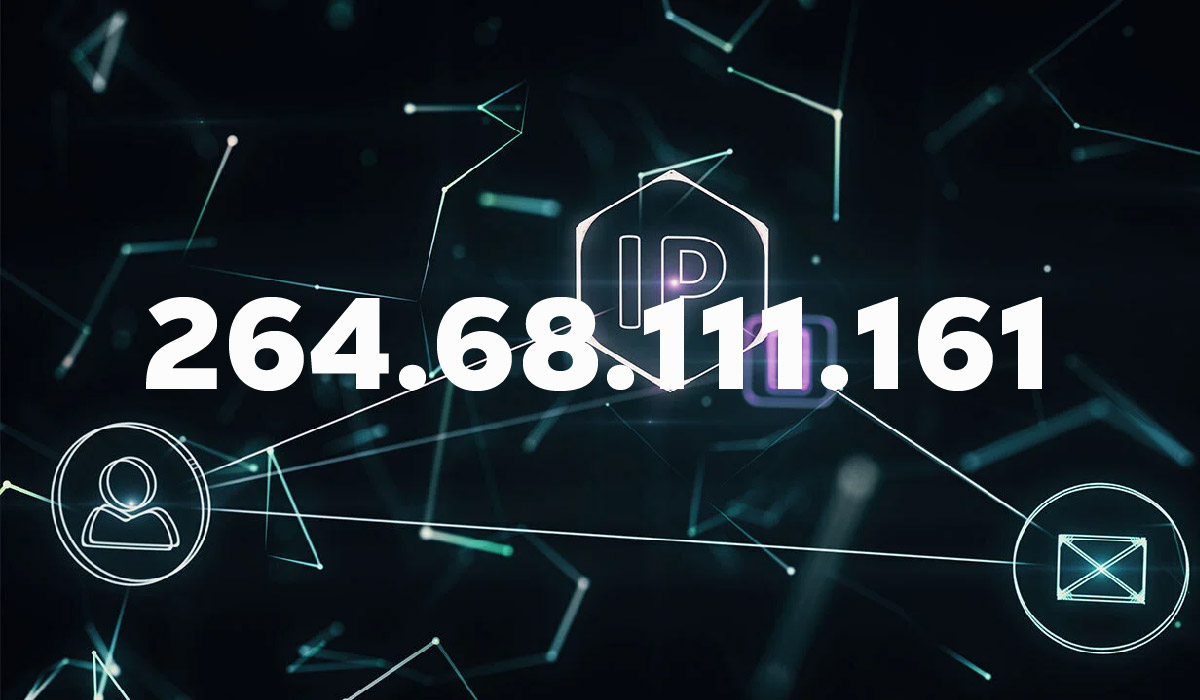
At first glance, 264.68.111.161 looks like a completely normal IPv4 address. It follows the familiar dotted-decimal format we have all seen countless times—four numerical segments separated by periods. To someone casually browsing network logs or configuration files, it might not immediately raise suspicion. However, when examined closely, this address reveals something fundamentally important about how internet addressing actually works.
IP addresses are the backbone of digital communication. Every website, server, router, and connected device relies on a structured addressing system to send and receive data. When you type a website name into your browser, your device ultimately connects to a numerical IP address behind the scenes. These numbers are not random; they follow strict technical standards defined by organizations like the Internet Engineering Task Force (IETF) and managed globally by the Internet Assigned Numbers Authority (IANA).
The interesting twist with 264.68.111.161 is that it appears valid in structure but fails in technical reality. In this article, we will explore why this address is invalid, what that tells us about IPv4 addressing rules, how IP allocation works, security implications of unusual addresses, and what this means for developers, system administrators, and everyday users. By the end, you will not only understand why 264.68.111.161 cannot exist in practice, but also gain a deeper understanding of how the internet’s addressing system truly functions.
Understanding IPv4 Structure and Limits
To understand why 264.68.111.161 is problematic, we need to start with the fundamentals of IPv4. IPv4 (Internet Protocol version 4) addresses are 32-bit numbers. These 32 bits are divided into four 8-bit segments known as octets. Each octet can represent a number between 0 and 255.
This limitation is not arbitrary. An 8-bit binary number can only represent 256 possible values, ranging from 0 (00000000) to 255 (11111111). Therefore, each section of an IPv4 address must fall within this range. Any number above 255 immediately violates the protocol standard.
Now let’s apply this to 264.68.111.161. The first octet is 264. Since 264 exceeds 255, it cannot be represented within 8 bits. This alone renders the entire address invalid. No router, server, or networking device will accept it as a legitimate IPv4 address.
This is an important distinction: the address looks syntactically correct in terms of format, but it is numerically impossible under IPv4 rules. In networking, structural validity is not enough; numerical constraints are equally critical.
The Role of Standards in IP Addressing
The internet operates because of strict technical standards. These standards are developed and maintained by organizations such as the Internet Engineering Task Force. The IETF publishes RFCs (Request for Comments), which define how internet protocols function.
IP address allocation itself is coordinated by the Internet Assigned Numbers Authority. IANA delegates large IP address blocks to Regional Internet Registries (RIRs), which then distribute them to ISPs and organizations.
Because IPv4 addresses are finite (about 4.3 billion total), their allocation is tightly controlled. An address like 264.68.111.161 does not just break a mathematical rule—it lies completely outside the globally defined IPv4 address space.
This strict governance ensures consistency. Without these standards, routing across the global internet would collapse into chaos. Every router in the world depends on the shared agreement that IPv4 octets range only from 0 to 255.
 IPv4 vs IPv6: Could 264.68.111.161 Exist Elsewhere?
Given that IPv4 cannot support an octet value above 255, some might wonder whether 264.68.111.161 could belong to IPv6. The short answer is no.
IPv6 addresses are structured very differently. Instead of four decimal numbers, IPv6 uses eight groups of hexadecimal numbers separated by colons. A typical IPv6 address looks something like:
2001:0db8:85a3:0000:0000:8a2e:0370:7334
Clearly, 264.68.111.161 does not match that structure either.
IPv6 was introduced to address IPv4 exhaustion. With 128 bits instead of 32, IPv6 provides an almost unimaginably large address space. However, it follows its own strict formatting rules. Therefore, 264.68.111.161 is invalid in both IPv4 and IPv6 contexts.
Why Invalid IP Addresses Appear in Logs
Despite being technically impossible, addresses like 264.68.111.161 sometimes appear in logs, datasets, or even spam emails. There are several reasons for this.
First, it could simply be a typographical error. Humans make mistakes when typing numbers. A valid address like 246.68.111.161 could easily become 264.68.111.161 with a simple digit swap.
Second, it might be intentionally fabricated. In documentation, examples sometimes use obviously invalid IPs to prevent accidental real-world connections. While official documentation often uses reserved blocks like 192.0.2.0/24, some people invent clearly impossible addresses to avoid confusion.
Third, malformed data can occur due to poor validation in software systems. If a web form does not properly validate IP input, users could enter impossible addresses, and those entries might be stored in logs or databases.
Security Implications of Malformed IP Addresses
Invalid IP addresses are not just harmless mistakes; they can have security implications. Poor input validation is a common vulnerability in web applications. If a system accepts 264.68.111.161 without validation, it may also be vulnerable to more serious injection attacks.
From a cybersecurity perspective, validation of network input is essential. Firewalls, routers, and intrusion detection systems are designed to reject malformed addresses. Accepting invalid input can lead to unpredictable behavior or system crashes.
In some cases, attackers deliberately test systems using malformed inputs to identify weaknesses. While 264.68.111.161 itself poses no threat, the presence of such an address in logs might signal automated scanning or testing activity.
Good security hygiene requires strict enforcement of protocol rules. Rejecting any octet above 255 should be a fundamental validation step in networking software.
Educational Value: What 264.68.111.161 Teaches Us
Interestingly, 264.68.111.161 serves as a useful educational example. It demonstrates how superficial pattern recognition is not enough in networking. Just because something looks right does not mean it is valid.
Students learning networking concepts often memorize the dotted-decimal format without fully understanding the binary limitations behind it. Examining an address like this forces deeper thinking about how 8-bit numbers function.
It also reinforces the importance of binary math in network engineering. Every IPv4 address ultimately represents a 32-bit binary value. If any portion exceeds 8-bit capacity, the entire address collapses.
In this way, 264.68.111.161 becomes less of an error and more of a teaching tool.
Common Misconceptions About IP Addresses
Many people assume that IP addresses are assigned randomly. In reality, they are allocated in structured blocks and managed hierarchically. There are public addresses, private addresses, reserved ranges, and loopback addresses.
Some ranges, such as 10.0.0.0/8 and 192.168.0.0/16, are reserved for private use. Others are reserved for testing and documentation. However, none of these ranges permit octets beyond 255.
Another misconception is that any four numbers separated by dots automatically form a valid IP. As we have seen, numerical constraints matter just as much as formatting.
Finally, some people believe that invalid addresses can still somehow “exist” internally. They cannot. Network stacks are built according to strict standards. An address like 264.68.111.161 will always fail parsing at the protocol level.
The Broader Context: IPv4 Exhaustion and Address Management
Although 264.68.111.161 is invalid, discussions about IP addresses often lead to the broader issue of IPv4 exhaustion. With only about 4.3 billion possible IPv4 addresses, the internet has effectively run out of new allocations in many regions.
This scarcity is one reason IPv6 adoption continues to grow. Unlike IPv4, IPv6 offers approximately 340 undecillion possible addresses—a number so large that practical exhaustion is virtually impossible.
Still, IPv4 remains widely used due to legacy systems and compatibility requirements. As long as IPv4 is active, its strict 0–255 octet rule will remain in force.
Conclusion: The Significance of 264.68.111.161
At the end of the day, 264.68.111.161 is not a real IP address. It cannot exist within the IPv4 system because its first octet exceeds the maximum allowable value of 255. It does not fit IPv6 formatting either. Technically speaking, it is an impossibility.
Yet this impossibility is meaningful. It highlights the precision of internet standards, the importance of binary mathematics, and the need for strict input validation. It reminds us that the internet is not built on guesswork—it is built on carefully defined rules and globally enforced agreements.
Sometimes, the most educational examples are the ones that fail. 264.68.111.161 may not route traffic across the globe, but it successfully guides us toward a deeper understanding of how digital communication truly works.

Related Posts
185.63.263.20 – A Deep Dive into the Meaning, Context, and Implications of an IP Address

YF64JFV: A Deep Dive into Its Meaning, Applications, and Future Potential